Project overview
MagNa: Recovering
valuable resources
from seawater brines
MagNa is a research project co-funded by the European Commission that adopts a circular economy approach, extracting magnesium and sodium -valuable raw materials currently mostly imported from outside the European Union- from seawater brine to supply industrial value chains.
Our mission
To provide a sustainable and safe source of magnesium and sodium for various industries thanks to the development of industrial-scale recovery units.
To promote circular economy by encouraging the reuse of materials to decrease resource extraction.
To contribute to EIT RawMaterials’ mission of securing sustainable raw materials supply, advancing resource efficiency, and ensuring long-term environmental and economic benefits for European industries.
To minimise the environmental footprint of desalination, thus contributing to the prevention and reduction of water pollution.
NAME: MagNa
FUNDING: EIT RawMaterials
BUDGET: €2,540,331
EU CONTRIBUTION: €981,510
DURATION: 30 months (September 2025 – March 2028)
COORDINATOR: Cetaqua-Water Technology Centre
CONSORTIUM: AITASA-Aguas Industriales de Tarragona, Universitat Politècnica de Catalunya, SEURECA Veolia
DEMONSTRATION SITE: AITASA-Aguas Industriales de Tarragona (Tarragona, Spain)
MagNa in numbers
2540331 €
BUDGET
4
PARTNERS
30 months
DURATION
43K m3/year
Seawater Intake Capacity
Case study
AITASA-Aguas Industriales de Tarragona
In Spain, desalination is a key water strategy due to increasing drought episodes linked to climate change. As the leading industrial water supplier in Tarragona, AITASA specialises in desalination, water reclamation, and industrial symbiosis, making it an ideal demonstration site for MagNa’s brine valorisation technologies.
The MagNa solution
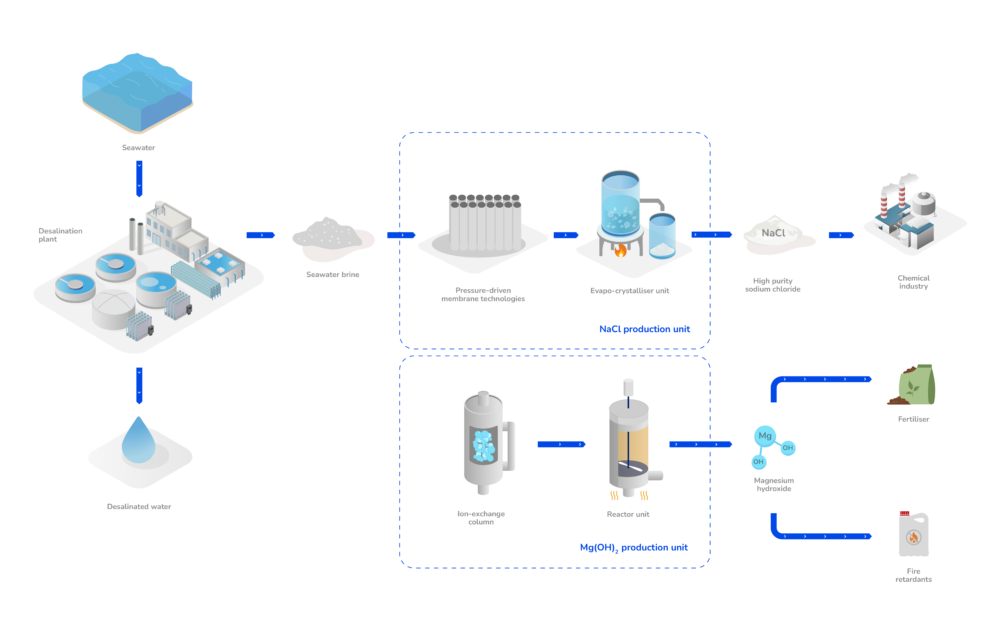
MagNa will demonstrate an innovative resource recovery treatment train to valorise seawater brines with great potential for application and replication. This treatment train consists of two modular process units for magnesium and sodium production at commercial scale, with innovation relying on optimising recovery and efficiency.